ML Verse

What is Machine Learning?
It is a branch of Artificial Intelligence (AI) that is used to build systems that rely on data provided to them. Instead of a specific rules to be written for a computer to do its job, the computer is given a large amount of data and it uses algorithms to discover the rules and patterns itself.
Traditional Programming vs. Machine Learning
Machine Learning is such a paradigm shift in the world of technology. Following provides a comprehensive comparison of traditional programming and machine learning:
❀ Traditional Programming: Logic first
In this approach, a programmer writes a manual script (rules) to process data.
- Example: A banking app.
The programmer writes a rule: "If account balance < $0, then send a 'Low Balance' alert." The computer simply follows that instruction every single time.
❀ Machine Learning: Data first
We give the computer the data and the desired answers, and it figures out the patterns itself.
- Example: A spam filter.
Instead of writing a rule for every possible spam word, you show the computer 10, 000 "Spam" emails and 10,000 "Not Spam" emails. The computer identifies the subtle patterns that make an email spam
Basic Terminology
1. The Data Building Blocks
- Feature: An individual measurable property or "variable" of the data you are analyzing.
- Label: The "answer" or the target you are trying to predict (e.g., the actual "price" of the house).
- Dataset: The collection of examples used for learning. It is usually split into:
- Training Set: Data used to teach the model.
- Test Set: Data used to see how well the model performs.
2. Training Terms
- Algorithm: The specific mathematical procedure used to find patterns in data (e.g., Linear Regression, Decision Trees).
- Model: The "finished product." It is what you get after you run an algorithm on your training data.
- Epoch: One full pass of the entire training dataset through the model. If you train for 10 epochs, the model has "seen" the data 10 times.
- Loss Function: A mathematical formula that calculates how "wrong" the model's prediction was. The goal of training is to make this number as small as possible.
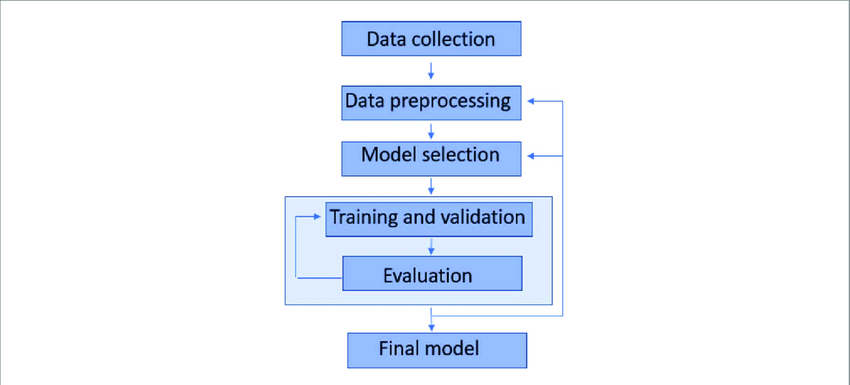
The ML Workflow