Supervised Learning
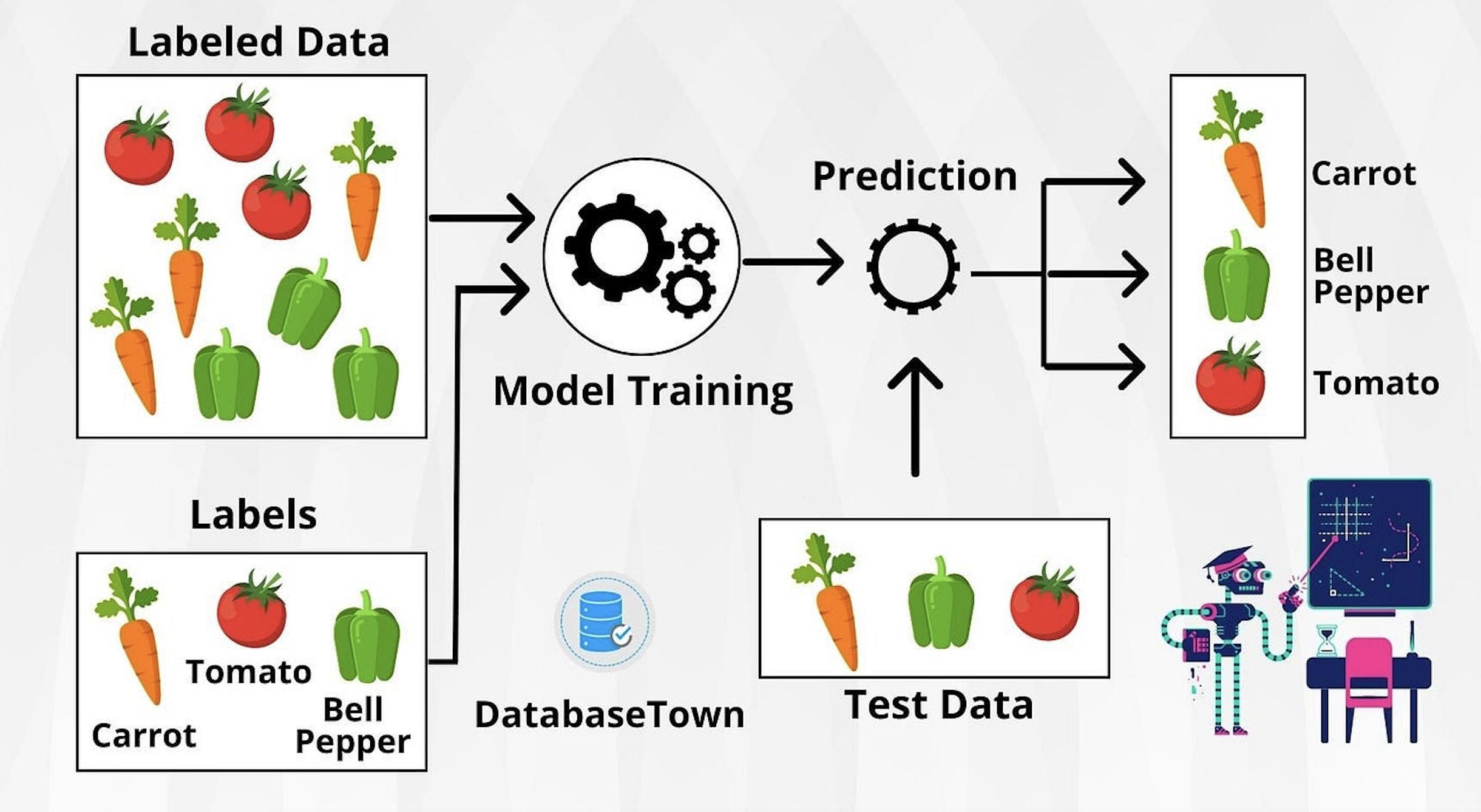
As the name suggests, the machine learns under supervision. And the supervision comes from using a labeled set of data. So, the set of data contains the input and the matching output. The machine learns from it and used it to make any predictions for new, unlabeled data later on.
☆ How it works?
- Collect the labelled data.
For example, emails labelled as 'spam' or 'not spam', if we want to build a Spam Email Detection Model. - Train the model.
- Optimize the model.
- Draw inference from the model. Give it an email unknown to the system and check if it makes the right prediction or not.
☆ The Two Main Categories
Supervised Learning can be divided into two categories: Classification and Regression.
1. Classification
This is used when the output is a category or a label. The computer is trying to draw a "boundary" between different groups.
- Is this image a cat or a dog?
- Is this credit card transaction fraudulent or legitimate?
2. Regression
This is used when the output is a continuous numerical value. The computer is trying to find a "best-fit line" that represents the relationship between variables.
- Predicting the exact price of a house based on its square footage.
☆ Strengths and Challenges
| Strengths | Challenges |
|---|---|
| High Accuracy: Because it has the "answers," it is usually more precise than unsupervised learning. | Data Hungry: It requires huge amounts of labeled data, which can be expensive and slow to create. |
| Ease of Evaluation: You can easily measure success by comparing predictions to the known labels. | Overfitting: The model might memorize the training data too perfectly, making it fail when it sees real-world data it hasn't seen before. |