Reinforcement Learning
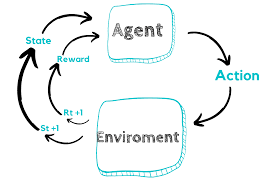
It is a branch of machine learning that focuses on how an agent learns to make decisions by performing actions in an environment to maximize a reward. It learns from its own experience, essentially through trial and error.
☆ How it works?
The core of reinforcement learning is a continuous feedback loop between the agent and its surroundings.
- Agent: The learner or decision-maker (e.g., a robot or a software program).
- Environment: Everything an agent interacts with (e.g., a game board or a physical room).
- State (S): The current situation or configuration of the environment.
- Reward (R): Feedback from the environment (either positive or negative).
☆ Key Concepts
1. Exploration vs. Exploitation
This is the fundamental trade-off in RL:
- Exploration: Trying new things to see if they lead to better rewards.
- Exploitation:This is used when the output is a continuous numerical value. The computer is trying to find a "best-fit line" that represents the relationship between variables.
2. The Policy (π)
The policy is the "brain" or strategy of the agent. It maps states to actions, telling the agent, "If you are in state S, you should take action A."
3. The Value Function (V or Q)
While rewards are immediate, the Value Function predicts the long-term total reward an agent can expect from a specific state or action. This helps the agent understand that a small reward now might lead to a huge loss later, or vice versa.
☆ Real-World Applications
- Gaming
- Robotics
- Healthcare
- Recommendation Systems